
The Myth Of The Tragic Troubadour
Thoughts On HBO Max's "It’s Never Over, Jeff Buckley," Plus: An Interview With Nate Amos Of This Is Lorelei

The great unsung “sliding doors” moment in the history of ’90s rock begins in the summer of 1993. Radiohead (of all bands) is at the original MTV Beach House in the Hamptons (of all locations). They look out of place, but not as out of place as you might expect. This is Radiohead 1.0, the band known only for “Creep.” At this juncture, nobody is betting on them one day becoming the decade’s defining English art-rock group. The band members look gawky and goofy, especially Thom Yorke. A bleach-blonde with a bad attitude, he sneers at the camera while singing “Anyone Can Play Guitar,” a deep cut from Radiohead’s debut Pablo Honey that only hardcore fans remember now.
Then something surprising happens: Thom decides to go swimming. His impromptu dive into a nearby pool is the sort of textbook rock-star gesture that he will forswear when he becomes an actual rock star. Only this particular rock-star gesture isn’t merely cringy, it’s potentially life-threatening. When Thom goes into the drink, he is fully clothed. And his wardrobe includes big black boots. While MTV’s cameras remain trained on the bombastic guitar playing of Ed O’Brien and Jonny Greenwood, Thom is pulled down as his footwear fills with water. Fortunately, his struggling is noticed by a 22-year-old PA named Adam Freeman, who along with another crew member rescues Thom from drowning.
Years later, Freeman recalled the words of a Capitol Records representative immediately after the incident: “You just saved that band’s career.”
During that same summer, in a different part of New York state, another young singer-songwriter with nice cheekbones and an impeccable high tenor records a live EP at Sin-é, an East Village dive bar. The four-song release includes two originals, “Mojo Pin” and “Eternal Life,” that will eventually be re-recorded for Grace, the full-length debut released by Jeff Buckley via Columbia Records the following year.
Five months before that album comes out, Buckley plays a show at The Garage in London that is attended by the members of Radiohead. The performance takes place amid sessions for their second record, The Bends. Things are not going well, and the concert outing is intended as a palate cleanser.
It works. Thom Yorke, in particular, is inspired by Buckley’s impassioned vocals, which are thoroughly out-of-step with the house style for male rock singers at the time. The wounded hyper-masculinity of Eddie Vedder is what’s in. But Buckley’s virtuosic four-octave range offers a stunning contrast. As seemingly every song that night at The Garage soars to a wild operatic peak, it sounds like he is trying to emulate Judy Garland, Robert Plant, Nina Simone, and Nusrat Fateh Ali Khan at the same time.
Radiohead goes back to the studio and reworks a song they have been wrestling with. It’s called “Fake Plastic Trees,” and Thom decides to sing it in falsetto, like Jeff Buckley. He does three takes and then bursts into tears. At first, he’s embarrassed by the display. But his band mates convince him that he’s finally nailed it. Later, in Jason Thomas Gordon’s book The Singers Talk, Thom seizes on this moment as a turning point in his career. “It reminded me of this vulnerable part of me that I was choosing to hide,” he says.
Flash forward to May of 1997. Radiohead has just put out their third album, OK Computer. Jeff Buckley meanwhile is still working on his second while living in Memphis. Unlike Radiohead, nobody thinks of him as a potential one-hit wonder. For one thing, Grace wasn’t actually a hit. But that doesn’t matter. He’s building toward something. A who’s who of rock legends — Dylan, Bowie, Plant & Page — have already sung his praises. Startlingly handsome and singularly talented, he is the opposite of gawky or goofy. His eventual ascent to all-time icon status seems all but preordained.
Then something surprising happens: Jeff decides to go swimming. Only he doesn’t dive into a pool, he wades into a tributary of the Mississippi River. He is fully clothed. He is wearing big black boots. While Led Zeppelin’s “Whole Lotta Love” plays bombastically on a nearby boombox, he is pulled down as his footwear fills with water. But there’s no 22-year-old MTV employee on hand to fish him out. And like that, the story of his life ends and the story of something else begins.
“The story of something else” is a familiar saga we’ll call The Myth Of The Tragic Troubadour. It’s a tale that gets told, time and again, about a coterie of singer-songwriters whose short lives and relatively small bodies of work are constantly repackaged, remastered, and reissued for new generations. It’s a quiet but steady business. Earlier this year, it happened once more with Nick Drake, an O.G. tragic troubadour, whose 1969 debut Five Leaves Left (one of three albums he recorded before his death by suicide at age 26 five years later) was expanded into a four-disc boxed set. And it happened with Elliott Smith, likely the definitive ’90s indie-rock tragic troubadour, whose final album with his pre-fame band Heatmiser was granted a deluxe 30th anniversary edition this summer, just a few weeks shy of what would have been his 56th birthday. (Smith died, also by suicide, in 2003.)
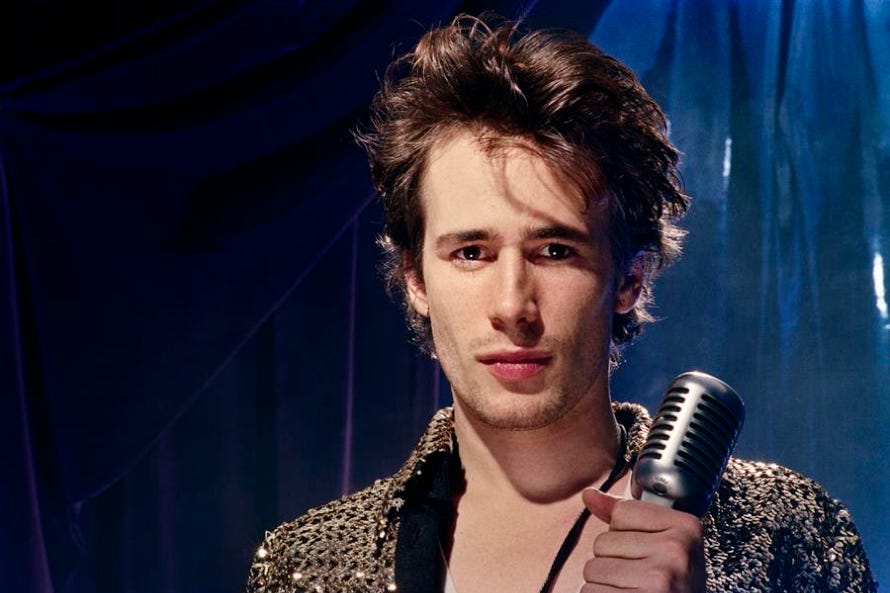
And then there’s Jeff Buckley, the subject of a new documentary directed by Amy Berg that premiered last August in theaters and this week on HBO Max. It’s Never Over, Jeff Buckley is 106 minutes, an impressive length given the brevity of the subject’s life and career. Even when compared with Drake and Smith, his discography is tiny — between Live At Sin-é, Grace, and another live EP, 1996’s Live At Bataclan, he put out just 18 songs in his lifetime. Some of those are different versions of the same songs, and about half are covers. Posthumous releases, including 1998’s Sketches for My Sweetheart The Drunk — the Tom Verlaine-produced LP he was making at the time of his death — have grown the catalog significantly. But Buckley’s career is still at least as much about promise as it is about actual music.
But what promise! Jeff Buckley, The Idea (possibly more than Jeff Buckley, The Person) has been extremely attractive for authors, filmmakers, and documentarians. Perusing Amazon, I counted four different biographies, along with multiple photography books by Merri Cyr (who snapped the cover pic for Grace), the de rigueur 33 1/3 tome on Grace, a collection of “musings” drawn from Buckley’s journals and early song drafts, an insider’s tell-all written by one-time collaborator Gary Lucas (co-writer of “Mojo Pin” and Grace’s title track), and a dual meditation on Leonard Cohen’s “Hallelujah” and Buckley’s transformative cover version (still his most popular track with more than 422 million streams on Spotify as I write this).
On YouTube, you can watch various documentaries, including a pretty good one produced by the BBC in 2002 called Everybody Here Wants You. Also: Can I also tell you about the Jeff Buckley biopic from 2012 starring Penn Badgley? I had no idea it existed either until I started researching this column. It’s called Greetings From Tim Buckley, and it focuses on a crucial bit of Buckley lore: In 1991, the late NYC music impresario Hal Willner organized a tribute concert to Tim Buckley, Jeff’s prodigal dad and another tragic troubadour who died of a drug overdose in 1975 at age 28. Jeff met his father (who he flatly referred to as “Tim” in interviews) a handful of times and turned prickly whenever reporters brought him up. But he agreed to perform at the concert, pointedly choosing a song, “I Never Asked To Be Your Mountain,” about Tim’s decision to abandon his family while pursuing a career in music.
It’s Never Over, Jeff Buckley covers that star-making performance as well as other biographical benchmarks — the intense boyhood connection to music and his uniquely Catholic tastes, the sometimes burdensome relationship with his mother Mary Guibert (an executive producer of the film), the struggle to escape his father’s shadow, his rise through the New York City music scene, his signing to Columbia, the torturously long tour cycle for Grace, his difficulties with songwriting, the pressures of following up the debut that eventually drove him to Memphis, and, of course, his senseless (and weirdly poetic) demise.
Along with crafting the most thorough and affecting cinematic portrait of the man, Berg admirably attempts to cut through Buckley’s well-trod mythology. The perspective of her film comes mostly from three women in his life: Guibert, the experimental artist Rebecca Moore, and musician Joan Wasser. The latter two were one-time lovers who are clearly still grieving his loss nearly 30 years later. (Wasser admits that she still can’t listen to his music.) As for Guibert, we see her openly weeping as she listens to the last answering machine her son ever left her.
It’s an appropriately intense watch for a movie about a man who made searingly intense music. Though the parts I appreciated most were the ones where Buckley speaks for himself. It’s always a little disorienting to be reminded of how young these tragic troubadours were when they died. It’s Never Over, Jeff Buckley doesn’t obscure his “20something-year-old rock star” foibles. An anecdote from Aimee Mann suggests he was a bit of a womanizer. Hints of substance abuse are made without being completely spelled out. It’s later theorized that he was bipolar, and that he had a psychotic break while trying to make his second record.
But while It’s Never Over, Jeff Buckley does give you a sense of the charming, complicated guy behind the legend, it can’t help but feed into the mythology. I don’t necessarily mean this as a criticism; the fact is that Jeff Buckley was mythic. The particulars of his life would register as “too on the nose” if a screenwriter invented them for a fictional movie about a musician who dies young. You’re telling me he drowned in a river at the foot of Beale Street, the birthplace of rock ‘n’ roll? And he was listening to Led Zeppelin as it happened? Yeah, right.
Because we all know how the story ends, it’s all but impossible to not frame the life of the protagonist through the lens of his untimely death. Moments of dark foreshadowing inevitably present themselves. In Berg’s film, we hear Buckley tell an interviewer that the song “Grace” is “basically a death prayer.” On his 29th birthday, he ominously declares that he’s now outlived his father. Wasser also recalls him telling her that “I’m not gonna last long.” As the movie nears its dreaded resolution, a bandmate likens Buckley to the big three of doomed rock stars: Jim Morrison, Jimi Hendrix, and Janis Joplin.
It’s hard now to listen to Grace without thinking about Buckley’s fate. But even without that context, it’s still a spooky record. On the cover, Buckley looks like an angel. His face is presented in profile, presumably as he gazes down through the clouds at an audience that won’t hear him until after he’s gone. And that’s before you even press play. Once you do, the way Buckley’s falsetto undulates at the start of “Mojo Pin” creates the sensation of being pulled into an otherworldly spirit realm. A few tracks later, there’s literally a song called “Last Goodbye,” where Buckley admits that “I’ll only make you cry.” After then comes the cover of Leonard Cohen’s “Hallelujah,” which Buckley forever changed from a horny old man’s hymn about sex to a mournful funeral dirge.
A feeling of preemptive sorrow pervades the record. On the best track, “So Real,” he plays a gorgeous guitar lick (written by bandmate Michael Tighe) that sounds like a slow-mo, sad-guy redux of “Kashmir.” It’s groggy and dreamy, the feeling of 6 a.m. after staying up all night. The verses are quiet and the chorus is loud, in the manner of countless mid-’90s rock songs. By the dynamics are setting you up for the song’s climax, where Buckley starts doing witchy Jeff Buckley things with his voice. “Real, real, reeeeeeeeeeeeeeeeeeeeeeeeeeeeeeeal,” he screams, for what feels like hours but is actually only about 12 seconds.
The rational part of your brain listens to “So Real” and thinks, “Wow, what incredible vocal technique.” But if I’m being honest, that’s not why I respond emotionally to the song. I respond emotionally to “So Real” because it sounds like the singer’s very soul is being ripped out of him. Maybe, the mythology suggests, it was.
Getting back to Penn Badgley: He’s not bad as Buckley! The scene from Greetings From Tim Buckley that stands out in my mind takes place in a record store. Jeff and his love interest Allie (based on Rebecca Moore and played by Imogen Poots) have ducked out of rehearsals for the tribute gig and embarked on a flirty sojourn about town. While scoping out the vinyl, Penn-as-Jeff enthuses about one of his favorite bands and launches into a virtuosic vocal medley of their hits. Only the band in question, Led Zeppelin, apparently didn’t give the filmmakers permission to use their songs, so Badgley gamely performs some Jackie Jormp-Jomp style facsimiles.
Greetings From Tim Buckley hints at Jeff Buckley’s secret superpower as an enduring tragic troubadour: His malleability. He’s proven that he can be reshaped into whatever the current moment requires. In the ’90s, Buckley straddled several seemingly incompatible worlds. He was a self-described “chanteuse” who spoke favorably of Edith Piaf’s “sexiness.” He was also a thinking-man’s hard-rock guy who palled around with Chris Cornell. And he was also a devoted fan of The Smiths who emulated Morrissey’s ability to concurrently project feminine sensitivity and masculine bravado. And he was also a conventionally attractive pop star who once was named one of People magazine’s 50 most beautiful people. (As It’s Never Over, Jeff Buckley notes, he tried to buy up every issue he could and wrote “kill me” over his cheesecake photo.)
Different audiences keep embracing different versions of Jeff Buckley. In 1991, he appealed to people because he reminded them of his dad. But over time, Jeff’s celebrity greatly outpaced his father’s. (I recommend that you check out Tim’s albums, and I demand that you read his Wikipedia page, particularly the “sex funk” section.) In that BBC documentary Everybody Here Wants You, he was redefined once again, this time as a prototypical male singer-songwriter in the same continuum as Bob Dylan and Bruce Springsteen. In It’s Never Over, Jeff Buckley, he gets yet another reboot as an artist who challenged male/female gender roles, again in accordance with contemporary cultural mores.
But what about his music? Here’s the part where I make a controversial statement: I don’t think Grace is an epochal masterpiece. Great record. Powerful record. But also a debut record. Like most debuts, it has a lot of ideas and not all of them are fully baked. It’s a little … much at times. Jeff Buckley’s voice was a wild buckskin stallion, and it sometimes ran a little rough and rowdy. As a songwriter, he was a guy in his 20s, with all the energy and naiveté that implies. He had a striking artistic persona, but there was room to grow.
Several of my favorite Jeff Buckley songs were intended for the second record, the one he wasn’t able to complete. Like “Vancouver,” a stunning sparkle-pop tune that showed he was just as capable of being Johnny Marr as he was Morrissey. Or “New Year’s Prayer,” a hypnotic Middle Eastern-flavored trip-hop number that resembles the electronic experiments Radiohead was still years from attempting. These were the seeds of a more nuanced and mature follow-up to his debut, his version of The Bends.
Those songs are also troubling, in that they are reminders that the comforting Myth Of The Tragic Troubadour story we love to tell ourselves over and over is ultimately an empty construction. We are drawn to these stories because they are narratively satisfying. But they are also obscure some unsatisfying truths. Unlike Nick Drake or Elliott Smith, Buckley did not engineer his own demise. He had problems, but he didn’t necessarily die because he was self-destructive. Nor did he make Grace to portend his own fate. He was just a young guy trying to start a career. And then, one day, this free-spirited person decided to take a swim. It was a random decision that in any other context would have meant nothing, except in this case he died. A freak accident. If he had jumped into a swimming pool at a beach house on MTV, it would have been an amusing footnote.
It’s Never Over, Jeff Buckley indirectly gets at what’s truly haunting about Jeff Buckley. It isn’t that his life had this romantically cataclysmic Shakespearan arc. It’s that he never got to have an arc at all. From an artistic perspective, his story is incomplete. Was Grace his peak? Or was it his Pablo Honey? We don’t actually know. We will never know. The depth of Jeff Buckley’s greatness is indiscoverable because it never fully manifested. His life was an album that cuts off in the middle of the first track, his creative potential a stack of unspent dollars in a dead man’s safe. The rest is a riddle without a punchline. He was in, in the end, a kid who wasn’t afforded enough time (or grace).
FURTHER READING
A lot of publications and websites put out their year-end lists this week, even though most of December is still ahead of us. (Mine is coming next week, with “only” half of December left to go. That’s what they call “editorial integrity.”) Last year, the early deadline caused most places to miss Cameron Winter’s Heavy Metal, one of 2024’s most momentous releases released in the middle of the year’s final month. This year, that great post-list season album is Holo Boy, the latest from This Is Lorelei due out Dec. 12. While not quite on the level of Heavy Metal, it nonetheless represents another step forward for the project’s pilot Nate Amos, who has shown (along with his stellar work in the anarcho-pop duo Water From Your Eyes) that he’s among the most talented indie artists this decade.
I interviewed Amos for Uproxx this week, and was impressed by his smarts and thoughtfulness. Here’s how I set up our Q&A:
To be clear: Holo Boy isn’t exactly “new.” It’s a 10-track collection of re-recorded tunes from the voluminous collection of Bandcamp releases — nearly 70 in all — that Amos accumulated before last year’s “proper album” breakout Box For Buddy, Box For Star. That LP — one of my favorite records of 2024 — established Amos as one of the most promising indie songwriters of his generation, evincing a gift for melody and songcraft that’s often submerged by the playful experimentation and willful strangeness of Water From Your Eyes. But hardcore fans keeping pace with Amos’ relentless output in the late 2010s and early 2020s were already aware of his preternatural gift for turning out hooky two-minute lo-fi pop songs laced with goofy eccentricity and sneaky melancholy, like a millennial Paul McCartney raised on Blink-182 and Chocolate And Cheese.
Holo Boy is an ideal opportunity to catch up for those who came on board with Box For Buddy. Essentially a “greatest hits” record covering his pre-“indie fame” output, Holo Boy functions as an easy entry point for the scores of dashed-off EPs and quasi-albums he rush-released before, during, and after the COVID era. “It definitely gave me the green light to really do nothing but work on music,” he says now of the shutdown, adding that he also felt little pressure to push those songs to an audience beyond the handful of die-hards paying close attention. But with Holo Boy, he’s finally nudging listeners toward infectious releases like 2019’s Move Around, the original source for one of the new album’s best songs, the wistfully stoned “But You Just Woke Me Up.”
Please read the rest here.
Finally , a take on Jeff Buckley I can stomach. Thank you , Steven. I never bought all the hype at the time. Talented ? Absolutely. Overrated? Definitely. He never got a chance to live up to his potential.
This is one of the clearest, most grounded pieces I’ve read on Buckley in a long time.
I really appreciated how you used the Thom Yorke near-miss as a counterweight—not just as a clever narrative device, but as a way of exposing how arbitrary some of this myth-making really is. Same impulsive act, same boots, two completely different stories. It drives home your central point that the “tragic troubadour” arc is something we build on top of essentially random events, then confuse for destiny.
I also like that you’re willing to say out loud that Grace is a brilliant but still very “first record” document. The way you talk about “Vancouver” and “New Year’s Prayer” as evidence of where he might have gone feels exactly right: you can hear the outlines of a more measured, stranger, and more mature artist starting to take shape. That sense of arrested development—the album that never quite got made—is far more unsettling than any tidy doomed-genius narrative.
And thank you for pointing toward Holo Boy in the back half. I love how you connect the Buckley story to Nate Amos’ hyper-prolific world; it’s a reminder that we’re living through a very different era of output and documentation, even as we’re still drawn to these stories of artists whose work is defined as much by absence as by what they actually got to leave behind.