


Thank you for reading Evil Speakers. My new book “Is This It: The Never-Ending Rise and Fall of The Strokes and Rock ‘n’ Roll” is out now wherever you buy books. You can read an excerpt from the book at The Ringer right now. I also did a really good interview with Anthony Fantano about it. And you can also check out this amazing New York Times review, which concludes with this touching passage not only about my book but about the value of longform music criticism in general.
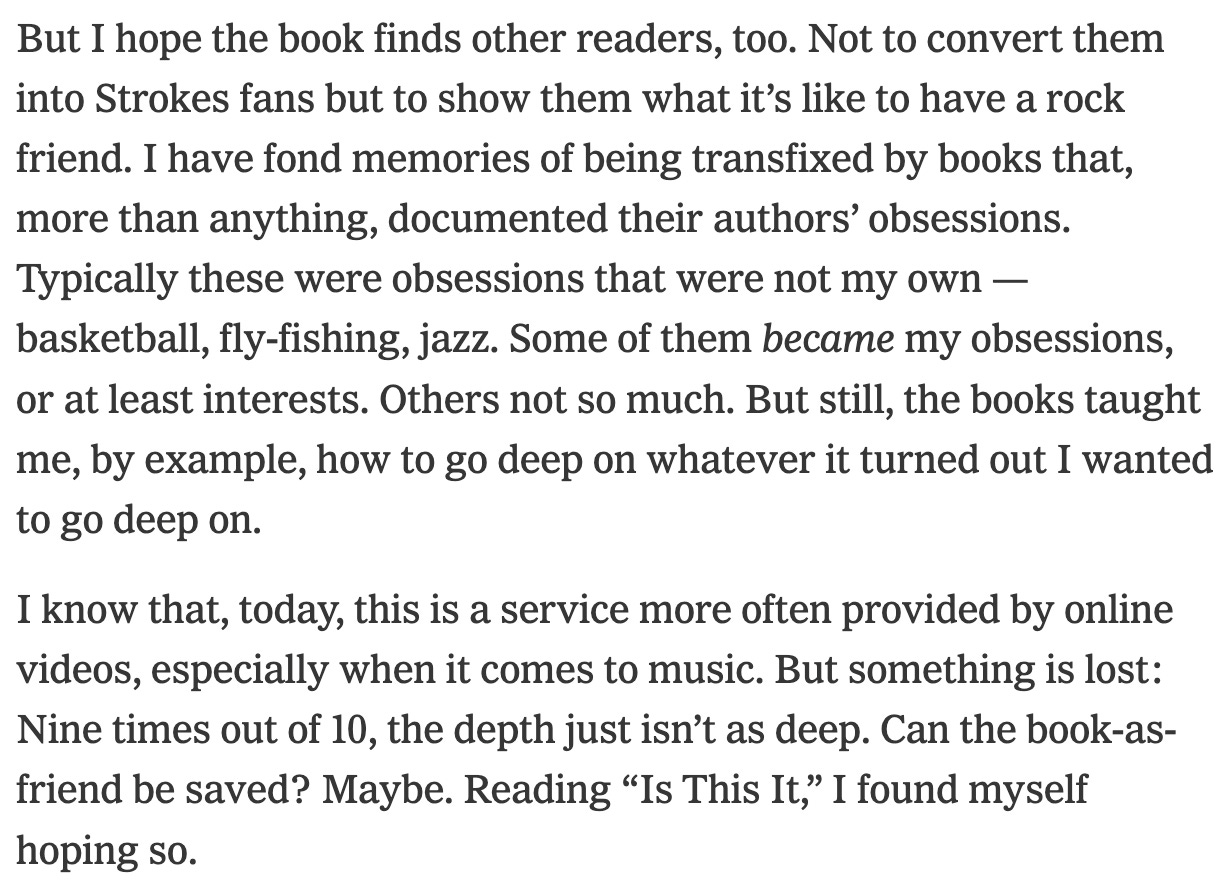
I hope so, too!
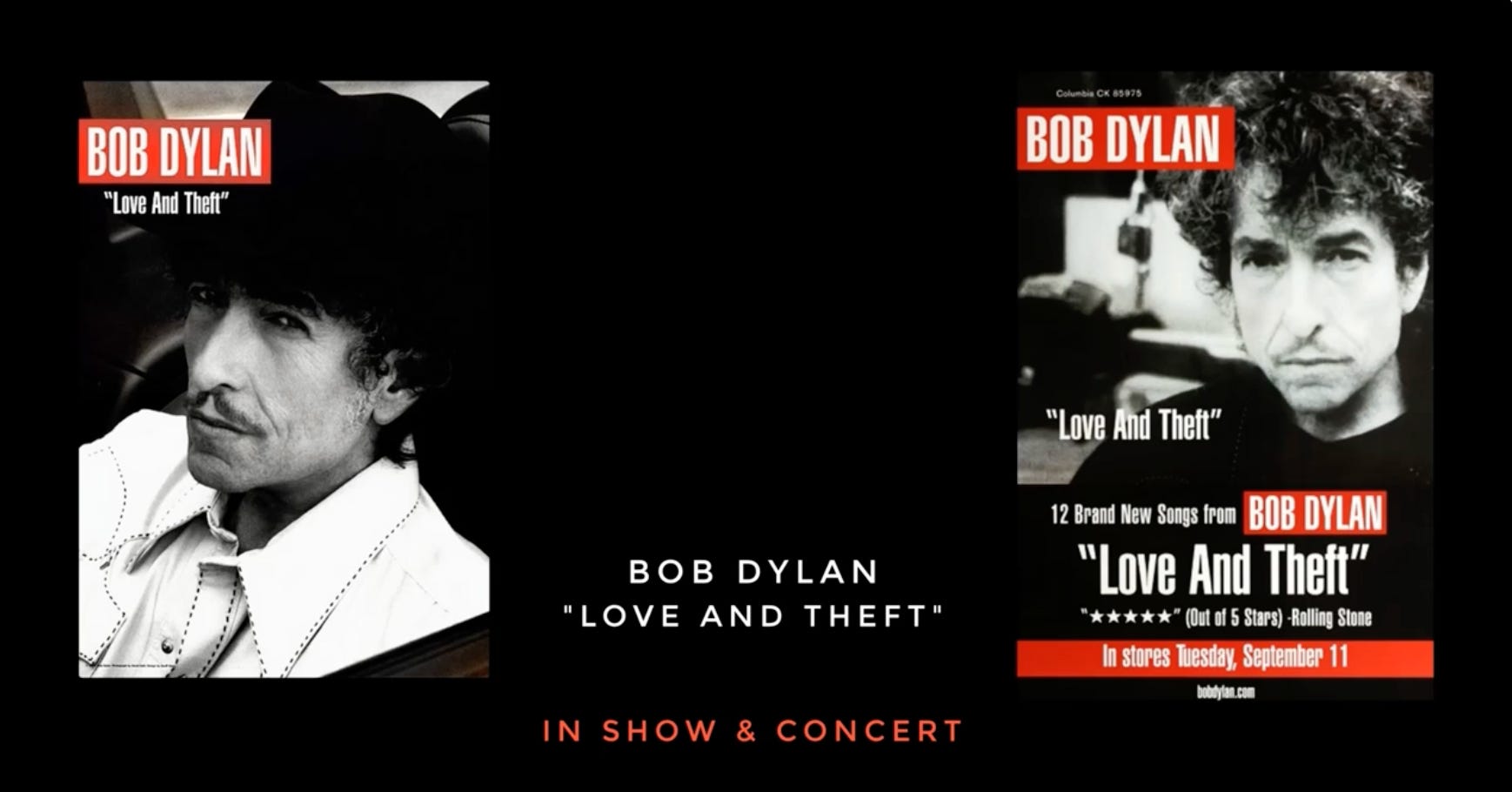
Speaking of which: In this essay, I write about the 25th anniversary of 9/11 and the albums associated with that day, including “Is This It” (which didn’t come out on Sept. 11) and Bob Dylan’s “Love and Theft (which did). Also, I review new albums by This Is Lorelei, Brian Fallon, The Tubs, and Lex Walton.
It started like any other morning. Only heavier, even before. I had just turned 24. I was older than I had ever been. Nearly 300 months old! And I felt like it. A weary soul, was I. Though maybe I felt so broken down and ancient because I woke up hungover on my couch, a real “morning like all the others” condition at the time. It was a Tuesday, which for me was like a Monday, since my weekends in those days were Sunday-Monday’s, a byproduct of being the least senior member on staff at my hometown daily newspaper, which stuck me with the least desirable schedule. I had come back home the night before from a few days in the Twin Cities suburbs, where my recently ex-girlfriend (her call) hosted me for “an ol’ times sake” type hang. On the drive home, it occurred to me that traveling five hours one way to spend my birthday with a girl who otherwise sought to keep a five-hours distance from me was not an especially promising snapshot of my life. When I got to my apartment, I immediately left again to meet a friend at our regular bar. We stayed until closing time, as usual. Which on a Monday was not that late, but still.
The morning after I turned on the TV as I cleared the sleep from my eyes. It was the Today show. I sort of paid attention to what they were talking about but not really. I got up and walked toward the bathroom shower. About 10 minutes later, I was back in front of the television, not really watching but taking it in via heartache-slash-Beam & Coke-impaired osmosis. Whatever is happening will be bad for only a little while, I absent-mindedly surmised, and then things will go back to being fine and forgettable. That was, after all, the rhythm of life as we knew it. Then I drove to the office, walked into the newsroom, and quickly learned that the United States was in the midst of an historic, cataclysmic and era-defining terrorist attack. The sort of disaster that instantly relegated my own petty, personal concerns to the status of ironic footnote in all subsequent reminisces of the day. Though, admittedly, my mind still lingered on how much it sucked being single again, even relative to the end of the American empire.
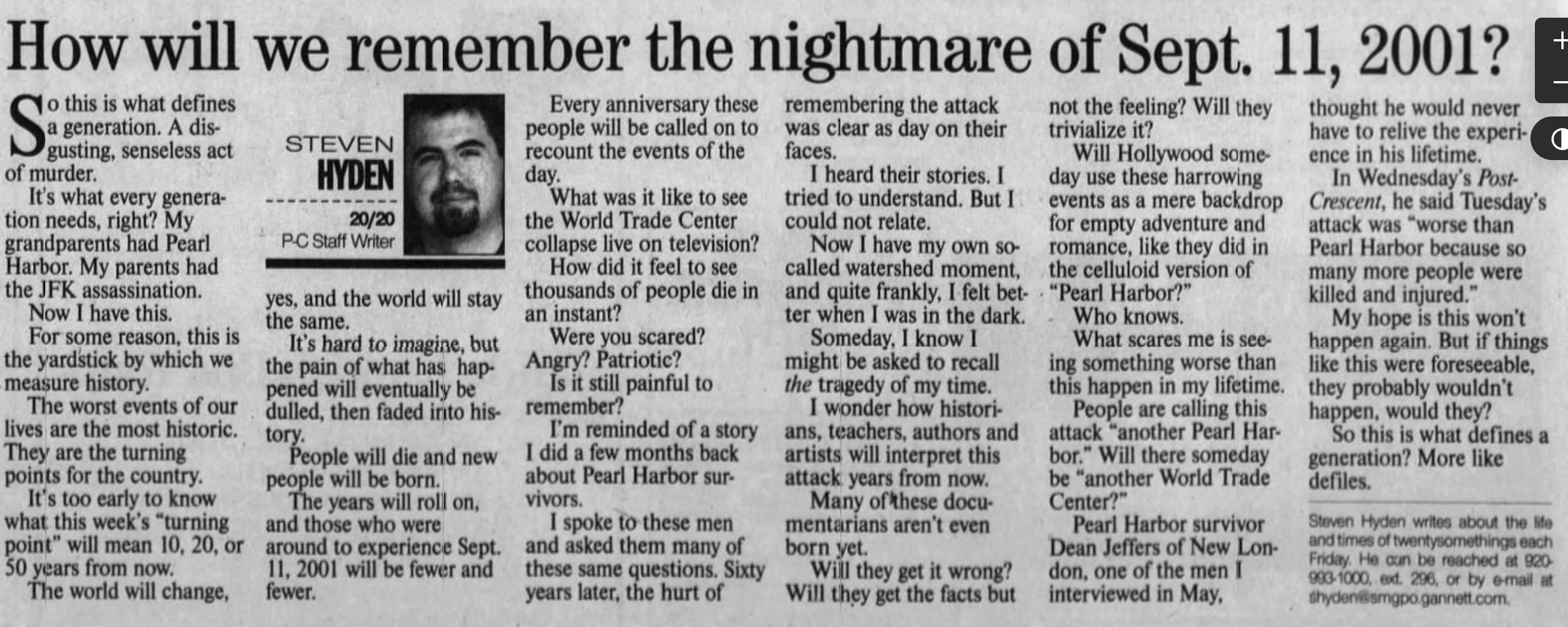
I spent the rest of the week “reporting” on what had happened, which considering I was 2,000 miles from Ground Zero amounted to the usual human-interest stuff with the all-important “local angle.” This, for instance, entailed spending time at a local nursing home and soliciting disinterested codgers and nice old ladies for their memories of Pearl Harbor, the only national disaster my editor could think to compare to whatever was happening now. I also wrote about the day for my weekly column, a regular showcase for my “young person’s perspective” so important to revitalizing the demographics of the paper. Normally, I wrote about records or movies or my comically poor eating and dressing habits. But now, I was asked to Deliver Something Deep & Profound About Current Events.
As a callow young man who wasn’t even 300 months old yet, I was out of my depth, clearly. So, I leaned hard on rhetorical questions and sanctimony, ponderously parsed out in one-sentence paragraphs. “So this is what defines a generation. A disgusting, senseless act of murder,” I wrote. “It’s what every generation needs, right? My grandparents had Pearl Harbor. My parents had the JFK assassination.” [Unnecessary and momentum-killing paragraph break.] “Now I have this.”
At the end of the column I did a callback to the lede in a manner I had learned from all the hacky newspaper columnists who came before me, a heritage of legendary non-oracles who were similarly tasked with pontificating in 16-column-inch bursts, no matter their hangovers or problems with their love lives. “So this is what defines a generation?” I concluded, to the proverbial us. “More like defiles.” Boom. Put a “-30-” on that sucker and keep an eye on the “Letters To The Editor” page for any “atta boy’s” sent in my direction.
The lesson here is that it’s very difficult to capture what exactly an event as large and tragic and important and ultimately incomprehensible as 9/11 is, right after it happens. And it’s doubly difficult to do it on purpose, at any time. Which is why, in terms of albums commonly associated with 9/11, all the most famous ones relate to the event accidentally. I just put out a book about one of those albums, Is This It by The Strokes. Is This It was supposed to be released in the U.S. two weeks after the attacks, but it was delayed two more weeks after that once the band agreed to remove the song “New York City Cops” and replace it with “When It Started,” in light of the heroism of NYC law enforcement and rescue workers. The chorus to “New York City Cops” — about how said officers “ain’t too smart” — was deemed insensitive in understandably sensitive times. This self-censorship gave the song a certain political cachet, even if the lyrics on the page read as fairly typical drunken barroom shit-talking, the lingua franca of Julian Casablancas’ lyrics on the record, more than a “statement” about policing. Like the other songs on Is This It, “New York City Cops” is an urban vignette taking place somewhere between the crappy apartments and shadowy dive bars the sorts of people who cared about The Strokes in 2001 also populated. (People like me, though my town was the opposite of NYC in every possible way.)
The standard line on Is This It vis a vis its status as a 9/11 record is that it depicts the resilience of young people living their lives and having a good time in the shadow of a turn-of-the-century apocalypse. I don’t question that narrative in my book, though I try to trace how it was formed. It seemed to happen almost instantaneously, a testament to how aligned the record was with the zeitgeist. By 2002, a columnist of the New York Times fortified the connection by declaring that The Strokes were “maybe even more of a band” in 9/11’s aftermath, “in the way that all sorts of 'brotherhoods' in the city — and not just firemen — seem tighter now.”
